One Beverly Hills: The Vision Transforming a Complex Corner of Beverly Hills
When Iconic Land Meets Urban Complexity
Some places only feel inevitable after they exist. Before that moment, they are debated, delayed, and often doubted.
One Beverly Hills fits this description perfectly.
Before construction cranes appeared along Wilshire Boulevard, the western gateway to Beverly Hills was defined by contradiction. The land surrounding the Beverly Hilton Hotel was globally recognized, yet fragmented. It was valuable but underutilized, iconic yet difficult to redevelop due to strict planning, design, and community standards.
Everyone understood the site's importance. Reaching agreement on how to transform it without compromising Beverly Hills’ identity was the real challenge.
A Development Strategy Built on Patience
When Cain International began pursuing the redevelopment, it quickly became clear this would not be a conventional project.
In Beverly Hills, scale alone does not guarantee approval. Height restrictions, traffic impacts, architectural character, public benefits, and long term city planning all receive intense scrutiny.
Developments that appear rushed or disconnected from the city rarely survive the approval process.
Rather than rushing forward, Cain adopted a patient approach. Years were spent refining the plan, engaging with the community, and aligning the development with Beverly Hills’ long term vision.
Instead of maximizing square footage, the priority became permanence. The goal was to create a development that could evolve with the city rather than dominate it.
Architecture Designed to Complement the City
The selection of Foster + Partners as master planner established the project’s architectural philosophy.
The globally respected firm focused on proportion, clarity, and integration. Buildings were not conceived as isolated towers competing for attention. Instead, they were designed as components of a larger environment.
Architecture would support the landscape rather than overshadow it.
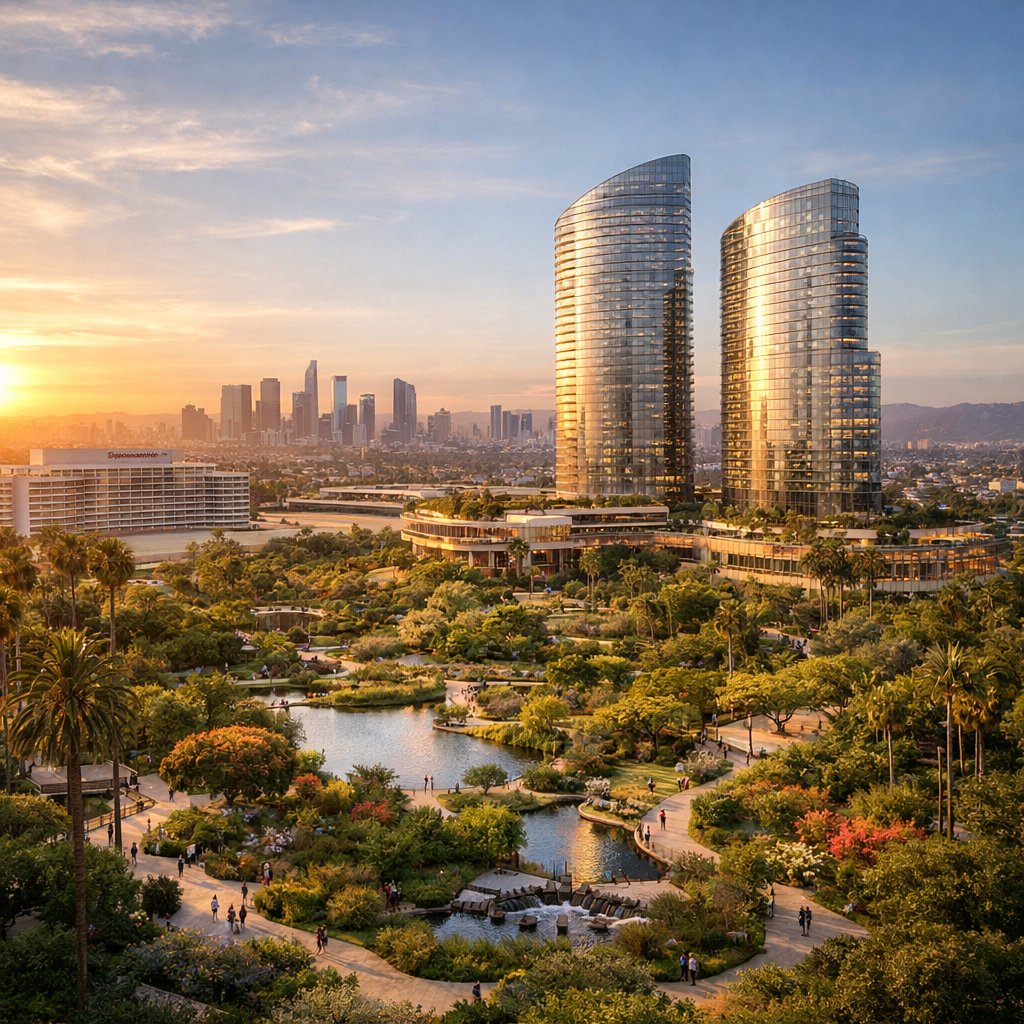
This concept expanded further when RIOS was brought in to design one of the project’s most distinctive features: ten acres of botanical gardens and open space.
In a city deeply protective of its character, leading with landscape transformed the conversation. The project was no longer simply about density or development scale.
It became about public realm, walkability, and long term civic value.
Aman Beverly Hills Elevates the Project Globally
As the vision evolved, One Beverly Hills reached a defining milestone.
Aman announced its first West Coast location at the project.
For the hospitality industry, Aman’s participation signals more than luxury. The brand is known for extraordinary selectivity, partnering only with developments that meet its global standards.
The inclusion of Aman Beverly Hills elevated the project’s stature internationally.
The plan now included:
-
An all suite Aman hotel
-
Two Aman branded residential towers
-
A private Aman Club designed by Kerry Hill Architects
At this point, One Beverly Hills was no longer simply a redevelopment project. It had entered the conversation as one of the most significant luxury developments in the world.
The Invisible Years of Construction
Even after groundbreaking in 2024, visible progress remained limited.
Much of the work occurred underground.
Demolition, infrastructure upgrades, utility relocation, and geothermal drilling required significant time and investment. These phases rarely produce dramatic visuals, but they create the foundation for projects intended to last generations.
This deliberate approach reflected the project’s broader philosophy: build for longevity, not speed.
When the Project Finally Became Visible
Late 2025 marked a pivotal shift.
With the first major concrete pours, vertical construction began and the vision started to take physical form along Wilshire Boulevard.
For the first time, what had been discussed for years was becoming visible to the public.
Turner Construction assumed leadership on site, coordinating a large network of architects, engineers, and specialty contractors working simultaneously across the property.
Curated Retail and Dining for a Global Audience
As construction progressed, the development’s broader ecosystem began to take shape.
Retail and dining partners were chosen carefully to match the project’s global hospitality positioning.
Early tenants include brands such as:
-
Dolce & Gabbana
-
Casa Tua Cucina
-
Los Mochis
These selections reflect a curated strategy rather than a high volume retail approach. The goal is to create a destination that attracts an international clientele while remaining consistent with Beverly Hills’ reputation for luxury and discretion.
Why One Beverly Hills Matters
What makes One Beverly Hills remarkable is not just its scale or its cost.
It is the discipline behind the project.
By prioritizing open space, integrating hospitality driven living, and committing to a slower development timeline, the project has advanced in a city where many large proposals stall indefinitely.
Instead of overwhelming its surroundings, the development attempts to extend Beverly Hills’ identity into its western gateway.
The Long Term Vision
Phased delivery is expected to begin in 2027, starting with Aman residences and select commercial spaces.
However, the real impact of One Beverly Hills will only be understood years later.
Its success will not be measured solely by architecture or sales prices, but by how people move through the space, how the gardens reshape the city entrance, and how Beverly Hills continues evolving while preserving the character that defines it.
Some developments chase attention.
Others earn trust.
One Beverly Hills chose the harder path.
- AMRE Real Estate Group
- Michael Abraham | [email protected] | DRE# 02242095
- Ania De Pourbaix | [email protected] | DRE# 01891438
- Compass Beverly Hills | DRE# 01991628
- [email protected]
- www.AMRE.Group
(323) 719-8585